Basic HTML Version


Nature and Biodiversity
79
Biodiversity Planning
In 2011, the EU adopted its 2020
Biodiversity Strategy (EC, 2011)
following recognition that the EU
had missed its 2010 target of halting
biodiversity loss. The EU strategy
has six main targets which focus on:
full implementation of EU nature
legislation; better protection for
ecosystems and more use of green
infrastructure; more sustainable
agriculture and forestry; more
sustainable fisheries; tighter controls
on invasive alien species; and a
greater contribution to averting
global biodiversity loss.
The National Biodiversity Plan
2011–2016 (DAHG, 2011) is the
main tool by which Ireland seeks to
meet its commitments under the
Convention on Biological Diversity
and the EU Biodiversity Strategy.
Reviews of implementation of
the previous National Biodiversity
Plan have reported mixed success
(DEHLG, 2005, 2010). Local and
public authorities and Government
departments were required under
the previous plan to make local/
sectoral biodiversity action plans.
The EPA and Bord na Móna
published biodiversity action plans
in 2010 (Bord na Móna, 2010;
EPA, 2012), and 26 local authority
biodiversity action plans are complete
or in the final stages of preparation.
As part of Ireland’s response to a
European Court of Justice ruling
action/threat response plans have
been published for 18 species of
high conservation concern and a
conservation plan for cetaceans
has also been published.
Biodiversity in the Wider
Countryside
Biodiversity is not evenly spread,
and certain species are more at
risk than others. Consequently EU
and national approaches afford
special attention to the protection
of sites of highest nature value and
species most at risk. However, they
also recognise that much of our
biodiversity lies outside protected
areas and effective conservation
and sustainable use of biodiversity
and the maintenance of essential
ecosystem services require action
in the wider countryside.
The Agri-Environmental Options
Scheme and the Natura 2000
Scheme, were launched in 2010.
The objectives of the schemes are
to promote biodiversity, especially
in Natura 2000 sites, improve water
quality and combat climate change.
These schemes aim at building on
the Rural Environment Protection
Invasive Alien Species
Invasive alien species are species that have been introduced
to Ireland, deliberately or accidentally, by humans and have a
negative impact on the economy, wildlife or habitats. Examples
of invasive species already established in our freshwaters are
the curly leaved water weed and zebra mussel. The cost of
alien invasive species in Europe is conservatively estimated
to be €12.5 billion/year and may be over €20 billion/year
(Kettunen et al., 2008). Invasive Species Ireland is a joint
venture between the Northern Ireland Environment Agency
(NIEA) and the National Parks and Wildlife Service (NPWS)
to co-ordinate activities on invasive species issues. Some
eradication efforts have been undertaken or are under way,
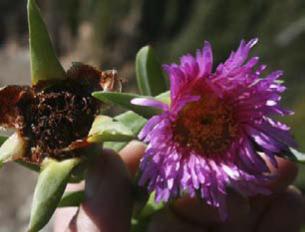
for example the hottentot fig on Howth Head. In addition,
the National Biodiversity Data Centre has developed an
online invasive species database and an early warning system.
Legislation controlling invasive species has been introduced
in the Republic of Ireland (S.I. No. 477 of 2011) and the EU
is planning legislation on invasive species in the coming years.