Basic HTML Version


Ireland’s Environment 2012
46
n
a decline in the length of seriously
polluted channel
n
an increase in the channel length
affected by slight to moderate
pollution – mainly due to
eutrophication (over-enrichment
of nutrients).
Monitoring for WFD purposes
commenced in 2007. Table 4.2
shows the breakdown in terms
of numbers of WFD water bodies
and their WFD ecological status (as
opposed to channel length, shown
in Figure 4.2). The overall ecological
status seems lower than that based
on individual sites and quality
elements. This is because the final
ecological status of a water body is
determined by the lowest status of
the available quality elements at each
site, and also by the lowest status of
the monitored sites within the water
body – there may be more than
one monitoring station within each
water body. The main success story
over the past eight years has been
the virtual elimination of seriously
polluted (bad ecological status)
river sites. The focus is now on the
moderate- and poor-status sites and
on the point and diffuse sources that
cause the pollution.
Table 4.2
River Water Quality in
Ireland – Ecological Status 2007–2009
(Source: EPA)
Ecological
Status
Number
of Water
Bodies
% of
Water
Bodies
High
204
13
Good
612
39
Moderate
435
28
Poor
295
19
Bad
18
1
Total
1,564
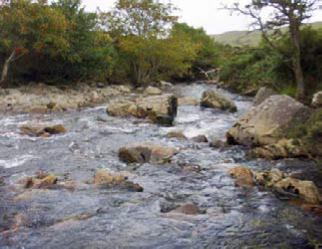
High-status waters such as rivers
with healthy populations of
freshwater pearl mussel require
very high standards of protection.
However, the number of such
high-status waters has declined
significantly in recent decades
(Figure 4.3). This decline is
worrying, and site-specific, targeted
interventions are needed in the
catchments with high-status sites
to prevent further loss.
Irish river water quality can be
compared directly with that of
other European countries using the
European Environment Agency’s
Waterbase database, which has
a representative set of nutrient
monitoring stations across Europe.
Ireland’s ranking for biochemical
oxygen demand (BOD), ammonia,
Figure 4.3
Trends in the Number of River Sites at High Ecological Status 1987–2009 Shown as Percentage of the Total
Number of Sites Monitored (Source: EPA)
0%
5%
10%
15%
20%
25%
30%
2007-2009
2004-2006
2001-2003
1998-2000
1995-1997
1991-1994
1987-1990
% Monitored Sites