Basic HTML Version


Ireland’s Environment 2012
128
It is estimated that full recovery of
ozone levels over polar regions will
take another 80 years. In Ireland the
EPA is the competent authority for
the implementation and enforcement
of legislation dealing with ozone-
depleting substances.
Ground-Level Ozone
The EPA monitors ground-level ozone
at a number of locations around
the country. The health information
threshold for ozone is 180 μg/m
3
,
and any exceedance of this threshold
must be notified to the public. The
EPA has issued a small number of
such public notifications in the past,
but ozone pollution does not pose
a significant risk to human health
in Ireland. Ozone results, updated
hourly, are available from the EPA
website.
Odour
Some of the substances controlled
under environmental regulations
are malodorous at concentrations
far below those at which toxic
effects occur. The WHO notes that
although odour annoyance cannot
be regarded as an adverse health
effect in a strict sense, it does affect
the quality of life. Odours are by far
the largest cause of complaints by
the public to the EPA, with waste
management facilities (including
landfill sites), rendering facilities,
composting activities and intensive
agriculture (rearing of pigs and
poultry) being typical sources of
these complaints. Such odours
constitute environmental pollution
and may be unlawful, depending
on a number of factors including
the offensiveness and intensity of
the odour, as well as frequency of
occurrence. Health effects from
exposure to odours include indirect
responses such as stress and sleep
disturbance through to more direct
symptoms including nausea.
A study on odour nuisance by the
Health Service Executive (HSE, 2010)
found that persistent, offensive
environmental odours were more
than just a nuisance and had the
potential to lead to short-term health
effects and decreased quality of life.
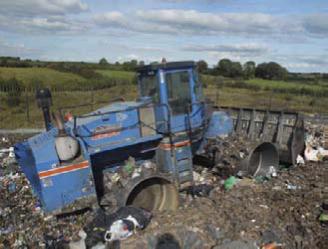
Waste landfills can be a major source
of offensive odours because part of
the waste is biodegradable and rots
easily to generate landfill gas. The
solution is to minimise generation of
biodegradable waste, increase home-
composting, divert biodegradable
material away from landfill to fully
enclosed composting or energy
recovery facilities and ensure good
odour management at all waste
sites. The biodegradable fraction of
landfill waste is decreasing as Ireland
implements the EU Landfill Directive,
which requires a significant reduction
in the amount of biodegradable
waste disposed of in landfills
(see Chapter 5).
Bioaerosols
Bioaerosols are airborne biological
particles consisting of a range
of micro-organisms and organic
constituents. Focus to date has
been mostly on
Aspergillus
fumigatus
, a fungus harmful to
health that is associated with
large-scale compost production.
Aspergillosis is a lung condition
caused by the fungus; most
cases have occurred in immuno-
compromised individuals and
instances of aspergillosis in healthy
individuals are rare. Bioaerosols do
not currently pose a significant risk
to human health in Ireland.
Noise
Excessive noise can seriously harm
human health and interfere with
people’s daily activities at school, at
work, at home and during leisure
time. It is perceived by the public
as a significant environmental
problem. It can disturb sleep,
cause cardiovascular and
psychophysiological effects, reduce
performance and provoke annoyance
responses and changes in social
behaviour. Research by the WHO and
the Joint Research Centre of the EU
shows that traffic-related noise may
account for over 1 million healthy
years of life lost annually in the EU
Member States and other Western
European countries (WHO and JRC,
2011).