Basic HTML Version


Environment and Health
123
Bathing Water
There are 135 designated bathing
areas in Ireland. Over the past 10
years the quality of water at these
sites has remained high, with the
vast majority meeting required
EU standards. Figure 9.3 shows
the quality of bathing water at
the designated bathing areas in
2011. Various factors contribute
to poor bathing water quality at
the remaining locations, including
inadequate sewage treatment,
discharges from combined storm
overflows and pump station failures.
The revised Bathing Water Directive
(2006/7/EC) places greater emphasis
on the protection of public health,
on the proactive management
of bathing water quality and on
greater public participation. It
establishes stricter microbiological
standards for two new parameters,
intestinal enterococci and
E. coli
,
and establishes a new classification
system for bathing water based on
four classifications – poor, sufficient,
good and excellent. Under EU law,
improvements are required to bring
all bathing waters to ‘sufficient’ by
2015.
Monitoring results indicate that there
is little risk to bathers’ health from
pollution in designated bathing areas
of the country. Occasional toxic algal
blooms in inland lakes can pose a
health threat to bathers, as blue-
green algae are toxic to humans
and animals. Bathers should avoid
waters showing signs of an algal
bloom. Members of the public
can find out about bathing water
quality on the EPA’s SPLASH website
(
www.bathingwater.ie
).
Shellfish
Irish coastal waters provide ideal
conditions for shellfish growth. In
order to support shellfish life and
growth and to contribute to the high
quality of directly edible shellfish
products, the Shellfish Directive
(2006/113/EC) and the Quality
of Shellfish Waters Regulations
(S.I. No. 268 of 2006) require the
development of Pollution Reduction
Programmes (PRPs) for designated
shellfish areas. Shellfish PRPs relate
to bivalve and gastropod molluscs,
including oysters, mussels, cockles,
scallops and clams. They do not
cover shellfish crustaceans such as
crabs, crayfish and lobsters.
The objectives of Shellfish PRPs
are to:
n
protect or improve water quality
in designated shellfish areas
n
achieve compliance with water
quality parameter values outlined
in Annex I of the Shellfish Waters
Directive (2006/113/EC) and
Schedules 2 and 4 of the Quality
of Shellfish Waters Regulations
(S.I. No. 268 of 2006)
n
determine the factors responsible
for any non-compliances with the
water quality parameter values
n
ensure that implementation of
the Shellfish PRPs does not lead,
directly or indirectly, to increased
pollution of coastal and brackish
waters.
Occasionally the primary foodstuff of
shellfish, phytoplankton (marine algae),
produces algal toxins that may
bioaccumulate in shellfish to such an
extent that they cause illness to the
consumer. To protect against such
illness the Food Safety Authority of
Ireland operates a strict shellfish
monitoring regime, in cooperation
with the Sea Fisheries Protection
Authority and the Marine Institute,
with shellfish samples being checked
before harvesting is allowed. The controls
are such that shellfish consumption
poses little risk to public health.
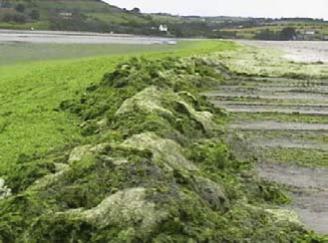
Sea Lettuce
Nitrogen-rich waters allow
opportunistic seaweed such as sea
lettuce to thrive, and this increased
growth of seaweeds is giving rise
to accumulations of sea lettuce on
beaches. In Brittany, France these
accumulations decaying on beaches
led to the death of animals and
injury to humans in 2009. Studies
by the French authorities concluded
that a significant risk was posed to
health from very high concentrations
of hydrogen sulphide just above
the piles of decaying seaweed
when the crust was breached. The