Basic HTML Version


Ireland’s Environment 2012
86
Introduction
Land and soil can be considered
as an integrated resource in the
broadest sense of the term. It is a
source of livelihood and enterprise; it
is the landscape in which we engage
with the world about us; it provides
the food, fuel, water, and the basic
materials for our wellbeing.
The Irish landscape is the direct
result of many hundreds of years of
human interventions and land use
change. Many of these changes were
driven by historical processes and
events, such as the forest clearances
prior to the 1700s, the Famine and
the depopulation of rural Ireland
from the 1850s through much of
the last century (CSO, 1997). More
recently the population growth of
the late 20th and early 21st century
led to an increase in the extent of
built-up areas. However, the overall
area of artificial surfaces remains
low in comparison with other EU
countries, and agriculture is still the
predominant land use in Ireland.
The soil of Ireland is an immensely
valuable national resource, which
formed and evolved slowly over
a very long period of time. The
regenerative properties of soil are
limited, therefore it is considered a
finite resource. Soil is a biologically
active, complex mixture of weathered
minerals, organic matter, organisms,
air and water that provides the
foundation for life in terrestrial
ecosystems. The general consensus
is that soil quality in Ireland is good;
however, this is based on limited
information.
The Current Situation
Land Use and Land Cover
Land use and land cover (LULC) are
the two main means of describing
and studying the form and function
of the national land surface. Land
cover is the physical description of
what is present on the surface of
the land, e.g. artificial areas, forest,
water bodies. Land use describes
the terrestrial environment from
the human perspective, focusing
on its socio-economic usage, e.g.
transport infrastructure, pastures and
recreational areas. Land cover and
land use are interdependent, and
changes in one impact on the other.
The main source of national scale
information on LULC in Ireland is
the EEA/EPA Corine land cover data
series, which delivered a 25 ha scale
land cover/land use map of Ireland
in 1990, 2000 and 2006, with
the next map expected in 2014.
Figure 7.1 shows the land cover in
Ireland compared to that for Europe
according to Corine 2006. The
main land cover type in Ireland is
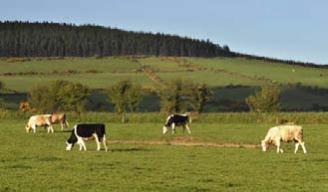
agricultural land, which accounts for
two-thirds of the national landmass.
Most of this is permanent grassland
pastures. Peatlands and wetlands are
the second most widespread land
cover type, covering almost one-fifth
of the country, while forested areas
Figure 7.1
Land Cover in Ireland and Europe, 2006 (Source: EPA, EEA)
0
10
20
30
40
50
60
70
Low Vegetation
Artifical Surfaces
Forest & Semi Natural
Wetlands & Waterbodies
Agricultural Areas
Percentage
Ireland
Europe